Follow Monica Davis and Atela Productions Inc. on LinkedIn:
Copyright © 2026 Atela Productions, Inc. All Rights Reserved.
Privacy Policy
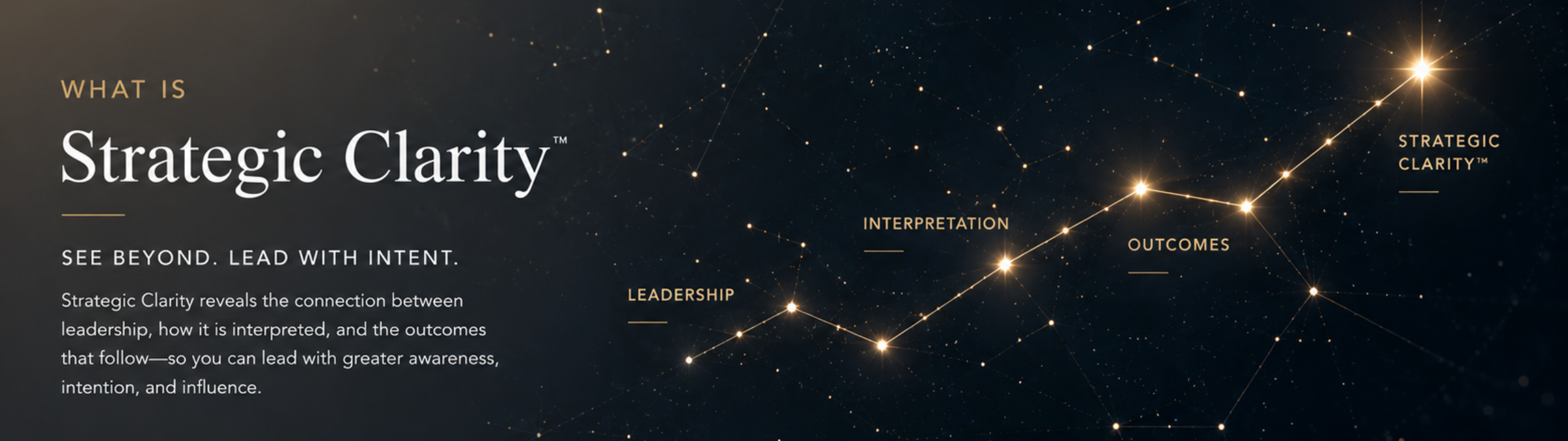
Over more than two decades of interviewing executives, entrepreneurs, business leaders, and innovators, I found myself returning to the same question.
How is leadership actually being interpreted by the people experiencing it?
That question gradually changed how I thought about executive communication. It also became the foundation of Strategic Clarity.
Strategic Clarity is the methodology I developed to help accomplished leaders better understand the relationship between leadership intention and leadership interpretation; recognizing that these two realities are not always perfectly aligned.
Rather than asking only, “What did I communicate?”, Strategic Clarity encourages a second question:
“What leadership did others experience?”
Throughout years of interviewing leaders and analyzing executive communication, I repeatedly noticed something that captured my attention.
Thoughtful leaders often invested significant time preparing for important conversations.
Preparation mattered and clear communication mattered. Yet audiences often carried away more than information alone.
They also formed impressions about judgment, confidence, consistency, decision-making, and leadership philosophy.
From one conversation to the next, I observed that those impressions often appeared to be influenced not only by the communication itself, but also by previous experiences, accumulated observations, and the broader context in which leadership was being experienced.
Those recurring observations ultimately inspired the Strategic Clarity methodology.
As I define it:
Strategic Clarity is the ongoing effort to better understand the relationship between the leadership a person intends to communicate and the leadership others consistently come to recognize through communication, decisions, and observable behavior over time.
That definition reflects years of observation rather than a claim that leadership can be reduced to a single formula.
Strategic Clarity is not built on the assumption that leaders can control interpretation. Nor does it suggest that every audience will interpret leadership in the same way.
Instead, it offers a practical way to thoughtfully explore how leadership may be experienced and where greater alignment between intention and interpretation may be possible.
In my experience, that understanding often provides a stronger foundation for intentional leadership than communication alone.

The Strategic Clarity Model™ organizes the methodology into three interconnected dimensions.
The decisions, communication, priorities, and observable behaviors through which leaders intentionally express their leadership.
How leadership may be experienced through the lens of previous experiences, accumulated observations, and organizational context.
The ways those interpretations can influence trust, credibility, executive authority, confidence, and strategic opportunity over time.
The model is not intended to simplify leadership. Its purpose is to provide a practical framework for thinking more intentionally about how leadership is experienced.
Many leadership development approaches begin by helping leaders improve communication. Strategic Clarity begins with a different question.
How is leadership already being experienced?
In my experience, that question often opens the door to richer conversations about executive authority, credibility, trust, and strategic positioning. It also encourages leaders to look beyond individual conversations and consider the broader patterns others may be recognizing over time.
Strategic Clarity does not replace thoughtful communication. It complements it by encouraging a deeper understanding of the leadership experiences that communication may reinforce.
Strategic Clarity was developed to be applied, not simply discussed.
The Strategic Clarity Audit™ provides leaders with an opportunity to explore how a single significant executive communication may be interpreted using the Strategic Clarity methodology.
The Authority Positioning Profile™ then builds upon those observations, helping leaders communicate the authority, judgment, and leadership they have already earned with greater clarity and intention.
Together, these engagements move from understanding to intentional leadership positioning.
I do not think of Strategic Clarity as a destination. I think of it as an ongoing leadership practice.
For that reason, Strategic Clarity is less about achieving perfect communication than about remaining curious enough to continually ask better leadership questions.
The most important question has remained remarkably consistent throughout my work:
What leadership are others experiencing that I may not yet fully understand?
For me, that question continues to define Strategic Clarity.
Copyright © 2026 Atela Productions, Inc. All Rights Reserved.
Privacy Policy